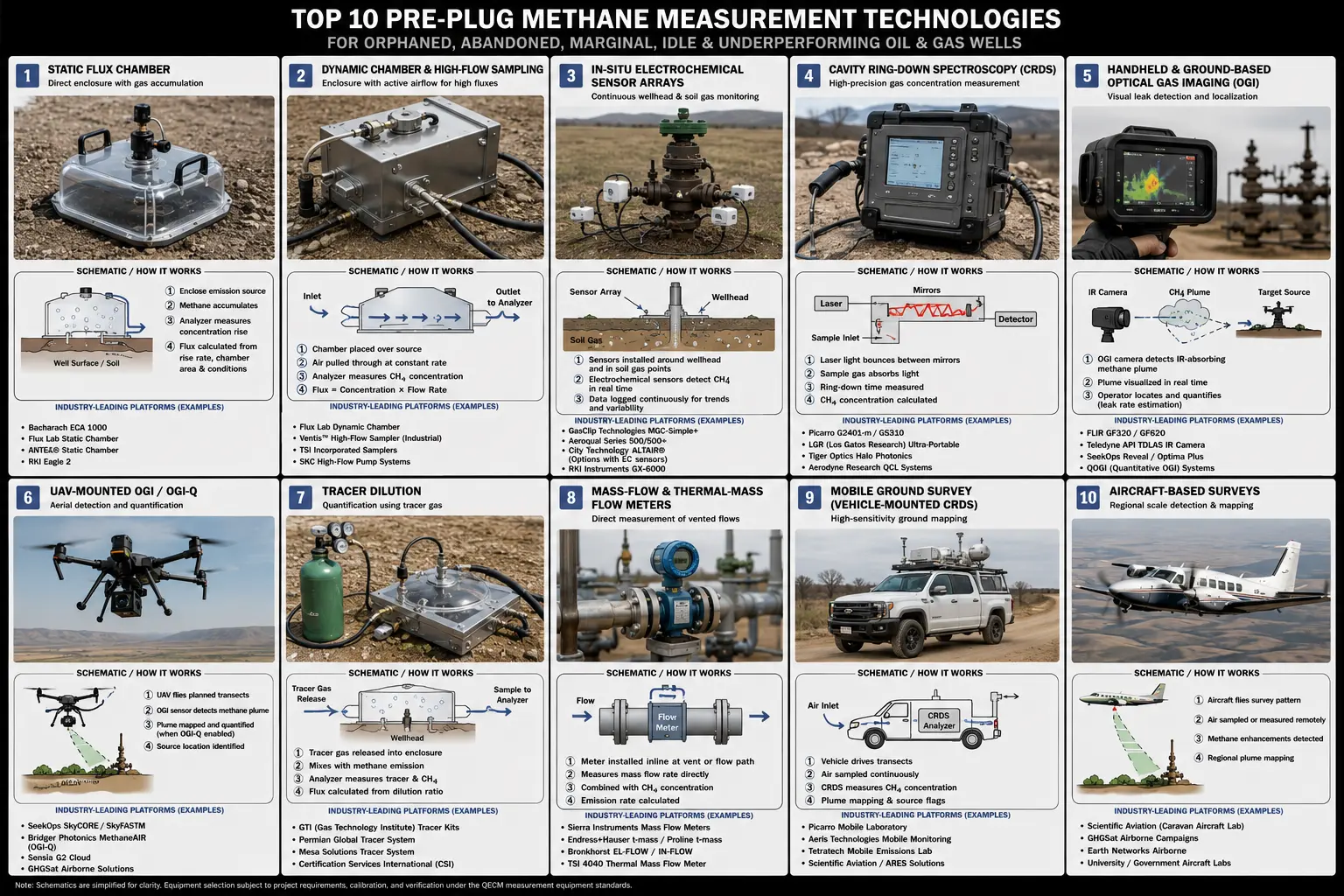
Measurement field guide
Ten technologies. Different jobs. Different risks.
Preview the measurement landscape, then download the complete 11-page reference.
Download field guide ↓
A longer treatment of methane urgency, project mechanics, quantification, methodology differences, quality controls, and buyer diligence.
Market figures and methodology status are time-sensitive. The governing project record and current registry documentation control.
These visual references support technical discussion without interrupting the primary narrative.
Preview the measurement landscape, then download the complete 11-page reference.
Download field guide ↓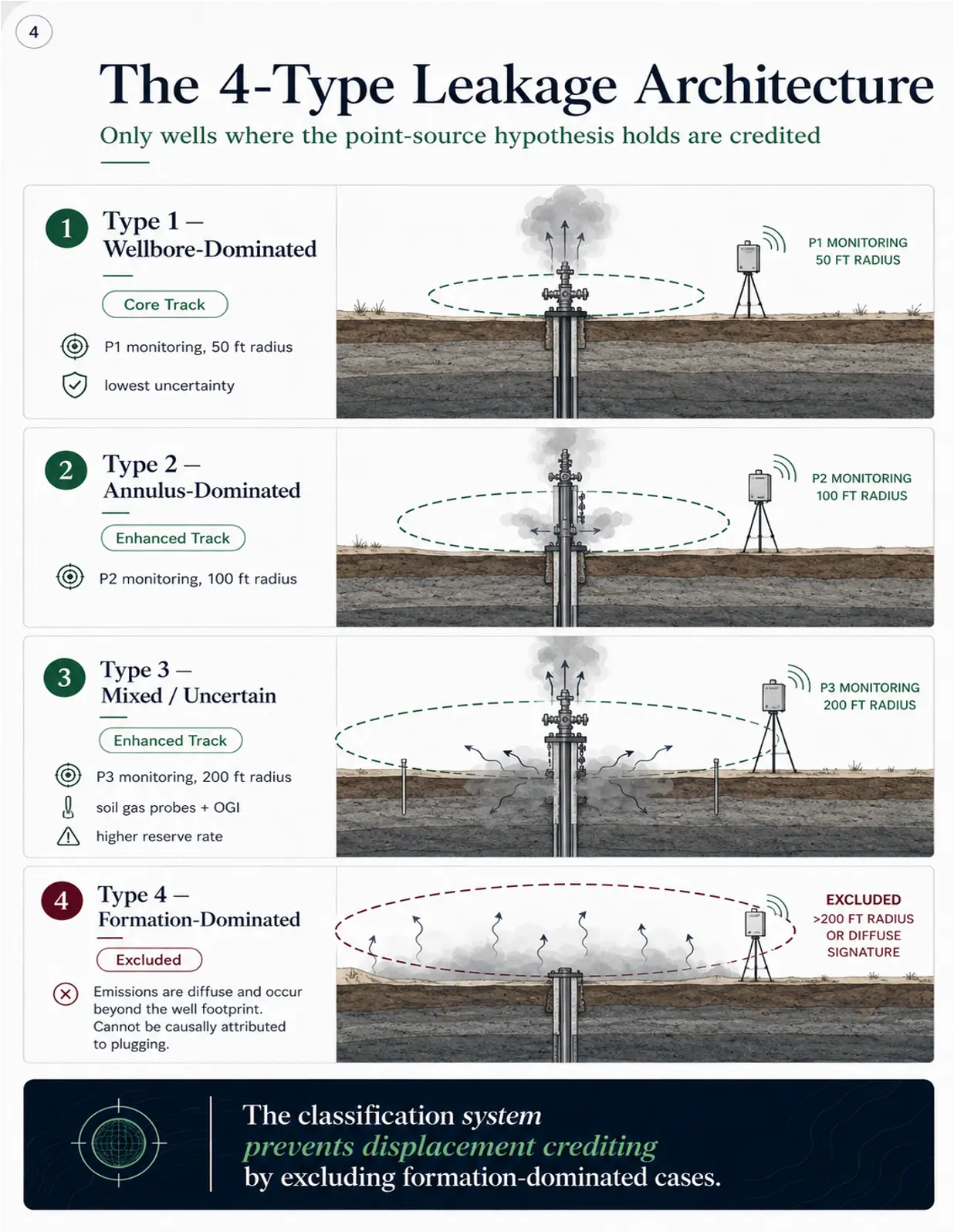
A risk-based classification that escalates monitoring and excludes formation-dominated cases.
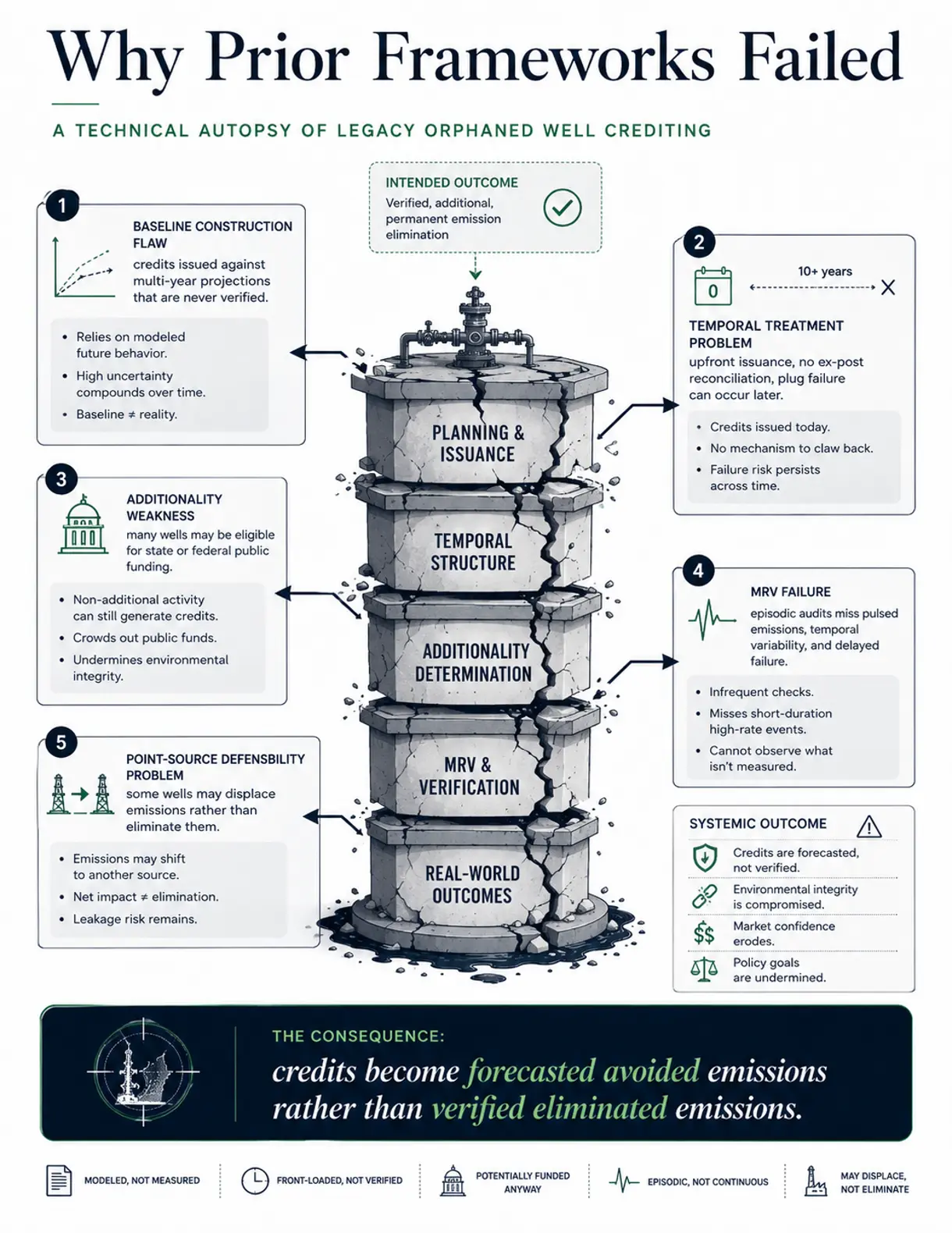
A visual autopsy of baseline, timing, additionality, MRV, and point-source weaknesses.
Illustrative technical references. Equipment examples, risk characterizations, and methodology fit remain subject to engineering, legal, verifier, and registry review before project use.
The intervention is strongest where the physical work and the public evidence tell the same story.
Near-term warming potency, atmospheric lifetime, and contribution to observed warming.
↗ 02 Methane emissions from U.S. low-production oil and natural gas well sitesNature Communications · Omara et al. (2022)National site-count, production, and emissions estimates for low-production facilities.
↗ 03 Orphaned wells methane measurement guidelinesU.S. Department of the Interior (2023)Federal pre- and post-plug measurement protocols and reporting logic.
↗ 04 Orphaned Wells Program annual report to CongressU.S. Department of the Interior (FY 2023)Reported field results for federally funded plugging, including measured methane reductions.
↗ 05 Natural gas and petroleum systems in the U.S. GHG InventoryU.S. Environmental Protection AgencyOfficial inventory methods and annexes for abandoned-well methane emissions.
↗ 06 Environmental risks and opportunities of orphaned oil and gas wellsEnvironmental Research Letters · Saint-Vincent et al. (2023)National analysis of environmental, climate, and community risks reduced through plugging.
↗ 07 Measurements show that marginal wells are a disproportionate source of methane relative to productionJournal of the Air & Waste Management Association · Deighton et al. (2020)Direct measurements at 48 very-low-production wells in southeastern Ohio, including the observed emissions distribution and national scaling estimate.
↗ 08 Addressing methane emissions is critical for fighting the climate crisisEnvironmental and Energy Study Institute · Lee (2022)Accessible synthesis of methane potency, U.S. source sectors, public-health relevance, and available mitigation opportunities.
↗ 09 Quantification of methane emissions from marginal oil and gas wellsU.S. Department of Energy · National Energy Technology LaboratoryMulti-basin field program measuring component-level emissions at 589 low-production oil and gas sites.
↗Find the source. Close the pathway.
Preserve the evidence. Return the land.